2. Bone Classification
The 206 bones that compose the adult skeleton are divided into five categories based on their shapes (see Figure 2.1). Like other structure/function relationships in the body, their shapes and their functions are related such that each categorical shape of bone has a distinct function.
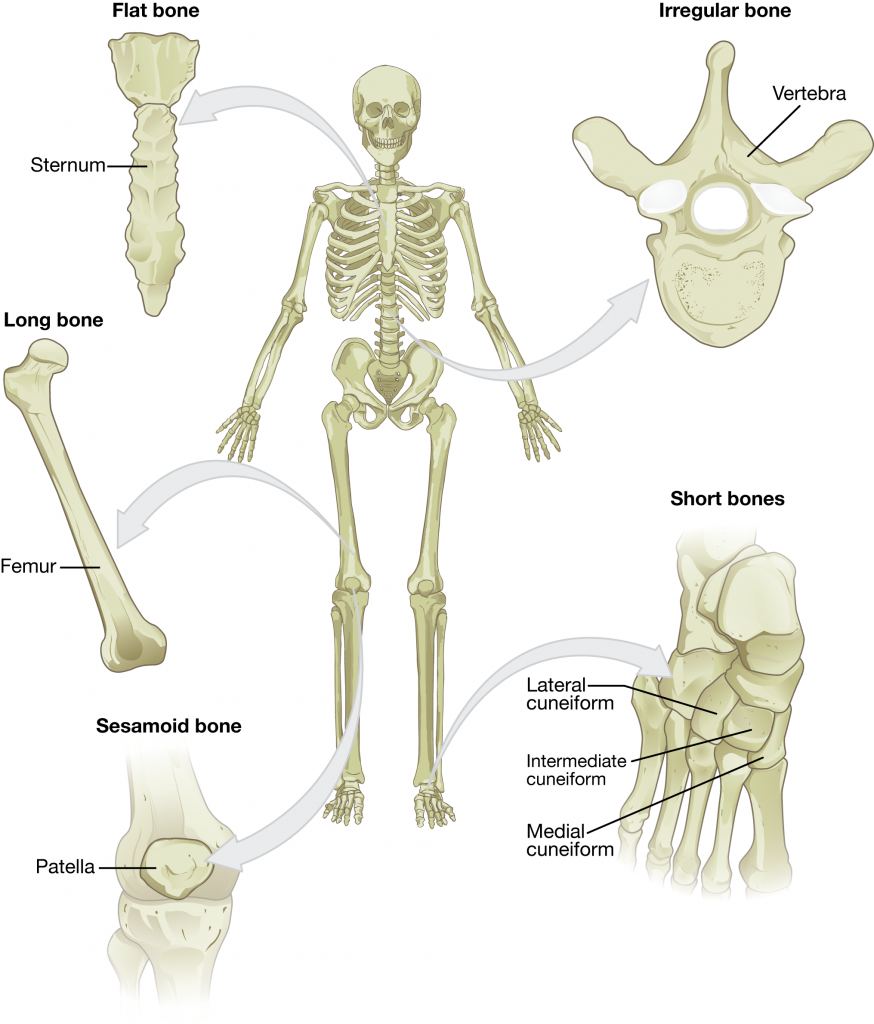
Long Bones
A long bone is one that is cylindrical in shape, being longer than it is wide. Keep in mind, however, that the term describes the shape of a bone, not its size. Long bones are found in the upper limbs (humerus, ulna, radius) and lower limbs (femur, tibia, fibula), as well as in the hands (metacarpals, phalanges) and feet (metatarsals, phalanges). Long bones function as rigid bars that move when muscles contract.
Short Bones
A short bone is one that is cube-like in shape, being approximately equal in length, width, and thickness. The only short bones in the human skeleton are in the carpals of the wrists and the tarsals of the ankles. Short bones provide stability and support as well as some limited motion.
Flat Bones
The term flat bone is somewhat of a misnomer because, although a flat bone is typically thin, it is also often curved. Examples include the cranial (skull) bones, the scapulae (shoulder blades), the sternum (breastbone), and the ribs. Flat bones serve as points of attachment for muscles and often protect internal organs.
Irregular Bones
An irregular bone is one that does not have any easily characterized shape and therefore does not fit any other classification. These bones tend to have more complex shapes, like the vertebrae that support the spinal cord and protect it from compressive forces. Many bones of the face, particularly the jaw bones that contain teeth, are classified as irregular bones.
Sesamoid Bones
A sesamoid bone is a small, round bone that forms in tendons (sesamo- = “sesame” and -oid = “resembling”). Tendons are a dense connective tissue that connect bones to muscles and sesamoid bones form where a great deal of pressure is generated in a joint. The sesamoid bones protect tendons by helping them overcome excessive forces but also allow tendons and their attached muscles to be more effective. Sesamoid bones vary in number and placement from person to person but are typically found in tendons associated with the feet, hands, and knees. The patellae (singular = patella) are the only sesamoid bones found in common with every person. Table 1 reviews bone classifications with their associated features, functions, and examples.
| Bone Classifications (Table 1) | |||
|---|---|---|---|
| Bone classification | Features | Function(s) | Examples |
| Long | Cylinder-like shape, longer than it is wide | Movement, support | Femur, tibia, fibula, metatarsals, humerus, ulna, radius, metacarpals, phalanges |
| Short | Cube-like shape, approximately equal in length, width, and thickness | Provide stability, support, while allowing for some motion | Carpals, tarsals |
| Flat | Thin and curved | Points of attachment for muscles; protectors of internal organs | Sternum, ribs, scapulae, cranial bones |
| Irregular | Complex shape | Protect internal organs, movement, support | Vertebrae, facial bones |
| Sesamoid | Small and round; embedded in tendons | Protect tendons from excessive forces, allow effective muscle action | Patellae |